Rachel Holowicki Explains When to Get a Psychoeducational or Neuropsych Assessment (and What It Really Unlocks)
Interview by Heather Anderson

If you’ve ever had that gut feeling that something has shifted for your child, or that school has turned into a daily stress spiral you can’t quite explain, you’re not alone. Rachel Holowicki, founder of Brain Waves Educational Psychology, helps families make sense of ADHD, autism, learning differences (like dyslexia, dysgraphia, and dyscalculia), anxiety, school refusal, and the “twice-exceptional” puzzle of kids who are both gifted and struggling.
In this Q&A, Rachel breaks down what assessments actually are (and what they’re not), how private evaluations differ from school testing, why the “label” fear is so common, and how the right data can become a roadmap for support, services, and a more sustainable day-to-day life at home.
For parents who are new to this world, what actually prompts someone to seek an educational or neuropsychological assessment in the first place?
Usually, something changes, or something starts to stand out.
Sometimes a child goes from from thriving to suddenly failing classes. Sometimes they were relaxed and outgoing but now they’re anxious, depressed, or shut down. Parents notice a shift. Teachers notice a shift. Or a school reaches out with concerns. Other times, parents bring concerns to the school pediatrician and are trying to collaborate, but they feel stuck.
A lot of families come in when they’ve already tried “the usual next steps” and they aren’t working. They’ve tried tutoring. They’ve tried extra help at home. They’ve asked for an IEP or a 504 and were told no. An assessment becomes the next step when families need clarity, and a more accurate understanding of what’s driving the struggle.
What are the most common situations you see that make parents say, “Something’s off, but I can’t quite name it”?
School refusal is a big one. A child starts going in late, skipping certain classes, or suddenly says, “I’m not going.”
Another common one is a major behavior shift or mental health shift. Parents will say it felt like it changed overnight, or it crept up over weeks or months.
Uneven skills come up constantly. A child might have a great vocabulary and be super articulate, and seem “so smart,” but struggle deeply with math. Or they can excel in math and science, but can’t read at grade level.
And there’s a pattern that breaks parents’ hearts: kids trying so hard, working so much harder than other kids, just to scrape by. Families are pouring financially and emotionally into tutoring, homework support at the kitchen table, and after-school help, and everyone is exhausted. That’s when the question becomes: at what cost are they “doing fine”?
I also hear this one a lot: “They can tell me the ideas out loud, but they can’t get it onto paper.” The child can discuss what they read and show comprehension verbally, but when it’s time to write, they freeze, write a couple sentences and get stuck, or it doesn’t come out the way it sounded in their head. That’s where things like dysgraphia can be part of the picture.

Before we go any further, can you explain in plain language what an educational or neuropsychological assessment is, and what it’s not?
A psychoeducational evaluation looks at cognitive skills and academics, plus social-emotional functioning. This is what your child would receive at a public school to determine if they qualify for special education or not.
Cognitive skills include things like verbal comprehension, visual-spatial skills, working memory, and processing speed. Academics include reading, writing, and math. Social-emotional pieces can include anxiety, depression, attention, and sometimes adaptive skills, like everyday living and functional skills (depending on what’s needed).
A neuropsychological assessment takes that deeper. It looks more in-depth at memory (short-term and long-term), executive functioning, attention and inhibition, language, sensory-motor skills, and how the brain is working across different systems. It’s more detailed, and it can help you understand what’s strengthening a child’s experience and what’s getting in the way.
What it’s not: it’s not medical care. I’m not a medical doctor. I can diagnose as a psychologist in private practice, but medical concerns should be discussed with a pediatrician or medical specialist as needed. It’s also not a magic wand. Assessments provide insight and a roadmap, but it’s still a journey. The report is often the beginning of figuring out what to do next.
How is a private assessment different from what schools typically provide, in terms of depth, scope, and usefulness for families?
I used to be a school psychologist in Chicago Public Schools and in San Francisco Unified, so I will never knock school psychs. They’re overloaded. Their caseloads are huge. They’re managing testing, counseling, crisis support, and timelines.
In schools, there’s a timeline to complete evaluations, and you have to work quickly and efficiently. You do the best you can, but you have many students waiting.
In private practice, I have more time to get to know the child, build rapport, and go deeper when something needs more investigation. If I get to “point A” and I’m not satisfied, I can dig further, add a measure, do another observation, ask more questions.
In schools, the primary question is often: Do they qualify for special education, yes or no?
In private practice, we can ask: what is really going on with your child, and what supports will actually help them to be successful at school, at home, and in the future?

Parents often worry that an assessment will “label” their child. How do you approach evaluations in a way that feels strengths-based and human, not clinical or reductive?
This matters so much. These are people’s kids. These are people’s babies. I completely understand that and take as much time and care as I can to treat everyone’s child like I would want someone to treat my son.
Parents already know what their child struggles with. They live it. They don’t need an hour meeting where nobody says anything positive. I’ve been in meetings like that, and it broke my heart.
So I start with strengths. I want to know who this child is. What are they great at? Music, art, humor, sports, deep interests, the things that make them unique.
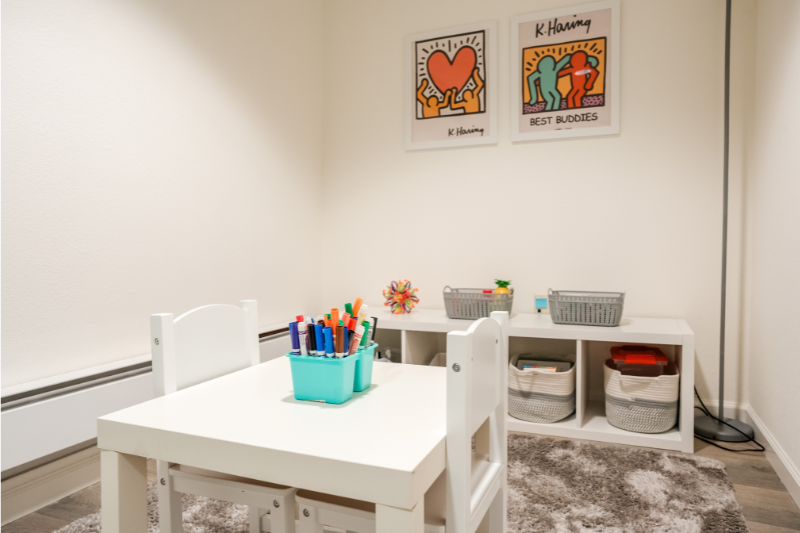
I also focus on comfort and regulation. Kids need to feel safe, respected, and comfortable to be able to engage. So I’ll ask: are you hungry, thirsty, hot, cold, do you need a break? We have flexible seating. They can sit where they want. They can fidget. They can stim. They don’t have to make eye contact. They can take breaks. We can play a quick game. This isn’t meant to be torture. It should be engaging and respectful. I want them to feel like they can be their authentic selves while they’re with me. I take a lot of pride in creating a safe, neurodiversity affirming space.
And afterwards, I can help parents explain results to a child in a developmentally appropriate way. This is for them. It’s about understanding how they learn and what supports help.
Once an assessment is complete, what kinds of clarity does it actually give parents? What questions does it answer that families are usually carrying around for years?
For many families, the first feeling is relief. Someone is listening. Someone is collecting real data across environments, not just one snapshot or a rushed assessment.
A lot of parents tell me they’ve been worried for years, begging for help for years, and they feel dismissed. So there’s validation in being taken seriously.
Assessments also answer the “why.” Parents often say, “I tried everything. I read with them. I sat with them. I got tutoring. I did my best. Why isn’t it working?” Clarity helps parents see: there is a reason they’re struggling, and it’s not because you failed as a parent.
Then we shift into: what will work now? We can look at what hasn’t worked, and build a plan based on a more accurate understanding of what’s actually going on.
You work with kids who are struggling, kids who are gifted, and kids who are both. Why are twice-exceptional kids so often misunderstood, especially in school settings?
Because people want neat checked boxes, and humans don’t work that way.
Twice-exceptional kids are often incredibly bright and also have a disability. That seems to confuse systems that are built to categorize and take a “one size fits all” approach to education.
In schools, if a cognitive assessment shows giftedness and grades look “fine,” the assumption can be: they don’t need help. But a child can be academically capable and still anxious, depressed, burned out, masking, or quietly drowning.
It’s often a “wait to fail” model. Families are told to wait until things are bad enough. That’s frustrating, because early intervention is so powerful. If we widen the lens beyond grades and ask about access to education in a more holistic way, we can see the whole picture of what’s really going on.
I hear parents say: “My child holds it together all day, and then melts down the second they get home.” That’s not a child who is “fine.” That’s a child paying a huge cost to look “okay.”
“Some kids are painfully aware they’re struggling compared to classmates. They’re sick of being told “try harder.” They’re sick of feeling not smart. So they avoid the place where that feeling lives all day.”
We hear terms like IEPs, 504s, accommodations, and services thrown around a lot. How does an assessment help families navigate those systems more effectively?
An assessment helps clarify the level of need and what environment will support the child best.
Does the child need general education with light support? Do they need more tailored placement? Do they need pull-out services? An aide? Specific academic or social emotional goals?
IEPs are for students who need specialized academic instruction due to a disability impacting educational access.
A 504 plan is generally for a medical condition impacting access, where the child may not need specialized academic instruction, but do need academic accommodations.
Accommodations are tools: extended time, movement breaks, access to a scribe, a sensory space to regulate, and other supports that help a student function and learn during the school day.
School refusal and anxiety have increased dramatically in recent years. When a child is academically capable but emotionally overwhelmed, how do you help families make sense of what’s really going on?
School refusal has increased dramatically since COVID.
The important thing is this: it’s not “just defiance.” There’s always an underlying issue. It’s often anxiety-based distress. It could be bullying, social anxiety, depression, fear of a specific teacher, or academic shame.
Some kids are painfully aware they’re struggling compared to classmates. They’re sick of being told “try harder.” They’re sick of feeling not smart. So they avoid the place where that feeling lives all day.
We have to dig deeper and find the root. When we treat it like laziness, we miss the actual need. All behavior is communication. If we want to understand, we have to listen.
You often ask, “At what cost?” Can you explain what you mean by that when a child appears to be “doing fine” on paper?
“At what cost” is about what’s happening behind the scenes.
The financial cost: tutoring, specialists, therapies out of pocket.
The time cost: hours at the kitchen table, every night.
The emotional cost: burnout, tears, meltdowns, exhaustion for the child and the parent.
If a child can only “pass as fine” with an unsustainable level of support, that’s not truly fine. It also raises the future question: what happens when those supports disappear, like in college or adulthood?
The goal isn’t just support. The goal is teaching strategies and building independence as much as possible. We want the child to learn tools they can use on their own, so they’re not being carried forward without skills.
For parents who disagree with a school’s evaluation, what should they know about Independent Educational Evaluations (IEEs) and their rights in that process?
If the school completes an evaluation and you disagree, you can say so. You can also point out areas you believe were not assessed.
Parents sometimes hear “they don’t qualify” and assume the conversation is over. It’s not.
You can request an Independent Educational Evaluation, which is a neutral, third-party evaluation. And a key point: IEEs are district-funded, so parents do not have to pay out of pocket when approved. The district contracts directly with the evaluator.
If a parent is feeling overwhelmed and unsure whether they need testing, therapy, or just guidance, how do you help them decide on a smart first step?
I offer a free 15-minute phone call to introduce myself, answer basic questions, and help families understand options.
Some parents truly don’t know what they need yet. We’ll talk about the difference between a psychoeducational evaluation and a neuropsych assessment. We’ll talk through concerns.
We can also tailor evaluations. Not every family needs “every test under the sun.” We can focus on the main referral question. Sometimes that means doing a screener first (like an autism screener), an observation, or teacher input, then deciding what’s appropriate.
And if what a family needs isn’t in my wheelhouse, I refer out. I’m connected to speech therapists, occupational therapists, and other clinicians. If I’m not the best fit, I will help you find someone who is.
What’s something you wish more parents understood earlier, something that could save them time, stress, or unnecessary conflict?
Early intervention matters. The sooner you start, the better the outcome.
If your gut says something is off, don’t let “wait and see” steal years. Parents are the experts on their own child. If you feel strongly, keep asking. Get another opinion.
Also: document everything. Put requests in writing. Keep emails. Keep a paper trail.
You can record meetings with notice. You can bring support to meetings, an advocate, a lawyer, or someone for emotional support. You don’t have to do this alone.
When families finish working with you, what do you hope they walk away with beyond a report, in terms of confidence or clarity?
I hope families feel empowered.
I want parents to feel informed, validated, and more confident advocating for their child. I want them to feel like someone listened, truly got to know their child, and created an accurate picture of who they are, not just a stack of scores.
And I want them to leave with a clearer understanding of what needs to happen next, so progress feels possible and support feels more realistic.
If a parent is reading this and wondering whether an assessment might help their child, what’s the best way to start, and what can they expect from that first step?
Start by reaching out and booking a free 15-minute intro call.
From there, we talk through the best assessment fit, funding options (private pay or district-funded in IEE cases), confidentiality and paperwork, and how to collaborate with the child’s therapy team or schoo.
Depending on what’s needed, I may observe the child at school, interview teachers or other providers, and complete testing over one or multiple sessions. After testing, I write the report and hold a feedback meeting with parents. Then, if the family wishes, we share the results with the school and develop a plan for accommodations and support.
Logistics vary. Some assessments take one session, others take three or four. A psychoeducational evaluation often involves around two to three sessions, and I typically block two to three hours each session. More complex profiles usually require more time, because different concerns require different types of assessment.

Want to learn more or take the next step?
Brain Waves Educational Psychology
Connect with Rachel on LinkedIn, Facebook or Instagram.
You can also find her on The M List, The Mamahood’s searchable database of mom-recommended resources, or connect and collaborate with Rachel inside of The Club membership for women Founders.